
Eli Ackerman welcomed everyone to RentCheck. Andrew Dunn from Hello Gravel kicked things off with a vibe check and a look at what's changed since September. Here's his presentation.
What's new
Claude is still the default model for most of the room. A few people reach for ChatGPT first, a few for Gemini, and a couple for Grok. Nobody raised a hand for the Chinese models.
Personal agents were the big topic. A good share of the room is already using one: Grok Bot, Meta's Muse, or OpenAI's dots, which launched at Dev Day. Anthropic announced Claude Duet this week, and a few people already have access. Apple's new Siri went into beta in September. Only one person in the room has let an agent spend money for them.
A lot of hands went up for running a website on WordPress, and quite a few people have cancelled a SaaS tool in the last few months because they built a replacement.
Andrew shared a post on X that framed the shift well. A year or two ago, you asked a question, the model made one call, and you got an answer. Now agents have arms and legs: they search, open a browser, and use your computer. The example was "watch my flights for the next two weeks and rebook if they get cheaper." That took only six model calls, because the agent spent its effort building software to do the job: a scheduled job, code to check airline prices, and a database to track them.
The week before, Tim Williamson hosted Jim Coulter for a conversation at The Nieux. Jim has New Orleans ties through his wife, and after Katrina he quietly funded the business students who came to help local entrepreneurs, which grew into New Orleans Entrepreneur Week and the Coulter Idea Pitch. Jim's numbers on venture capital in the first half of 2026 (Andrew checked them afterward and Jim was right):
| Where | VC invested, H1 2026 |
|---|---|
| Outside the US | $130B |
| US outside California | $100B |
| California | $400B |
| San Francisco (included in California) | $280B |
San Francisco took $136B in all of last year. Someone in the room added that OpenAI and Anthropic alone got nearly half of global venture capital in that period. Andrew showed a San Francisco house listing that accepted Anthropic and OpenAI stock as payment, and the run-up in Pokémon card prices.
Asked what to do about all of it, Jim said nobody knows whether AI saves us or ruins us, so the important thing is to stay curious and keep learning. He also said you can't learn AI alone at a computer the way people learned computer science. You learn it in a group, and New Orleans is good at forming krewes.
Andrew's ask for 2027: the people in this room are early, and a lot of New Orleans still only sees AI in a Google search preview. He wants us to carry what we're learning into the city's other communities (chefs, bartenders, hotel workers, river rats) so AI lands here like a flood instead of a trickle.
Panel: replacing WordPress with something you built
Eli moderated a panel with Brook Bissinger from Align and Andrew. Both replaced a WordPress site with a custom build in the last six months, and for both it was the most ambitious thing they'd tried with AI.
Align
Brook had been complaining about Align's WordPress site for months. At an earlier AI Friday, Max Materne told her to upgrade her Claude plan and just do it. The site was nine years old with more than 1,000 pages and a big blog, so she was nervous about wrecking the SEO. One Saturday morning she started. Her first message to Claude was short:
I'm ready to get off of WordPress for our Align site. Act as a modern web designer with a B2B background that also understands current SEO, GEO, AEO standards. I like the words on our site and we are sticking with our brand colors and logo. Create a plan I can give to Sonnet to execute. What do you need from me to get started?
Claude asked her what it needed, including a budget so she could make the case to Align's CEO before committing. She planned in chat, then built with Sonnet in Claude Code. It took about two weeks of near full-time work, and she hit the limit on the $100 plan three or four times a day in the first week. Halfway through she found Claude Code's remote control and started working from her phone. The previous version of the site was an agency project in the $20,000 to $30,000 range.
The new site looks the same as the old one, so she cut over all at once. She kept WordPress running for a month after switching DNS and needed it once, for a PDF that hadn't been copied over. A site health bot ran for the first week, checking for 404s, broken redirects, and missing PDFs. Everything lives in GitHub, and she's rolled back twice. There's no CMS. Her content writer has Claude Code and edits the repo directly.
On SEO, Brook said traffic has gone up. She added FAQs to the bottom of every page programmatically, which she couldn't do in WordPress, and set rules for what bots can see. On security, the front end runs on Vercel with bot protection, and her repos are separated so the website repo has no write access to her agents' repo.
The project kept going after the website. Align is now off HubSpot. Form submissions go through a router on Vercel into Supabase, then on to Salesforce or Customer.io. She's added agents in Slack that watch Salesforce and point her team to opportunities.
The direct savings are about $1,500 a year. Brook said the bigger return is that Claude read every word on her site and now knows Align's product and audience well. She can ask it to act as Align's CMO and review an email, and the feedback is good. She's sharing her prompt and plan in Slack.
Hello Gravel
Hello Gravel's site was WordPress with WooCommerce, spun up in 2023, with around 47 plugins by the end. Every change rippled through those plugins, and the team felt the website was slowing them down. Andrew's first prompt was basically "I'm sick of our WordPress site, it's so slow, go figure out what we need and rebuild it." The result was close enough to give them hope. He then had a separate session turn that into a migration spec. They built three versions on different stacks before settling. Andrew's view is that with today's models it often works better to describe what you're trying to do openly and let the model run than to write a tight spec up front.
The first version was mid-March and the new site launched June 8. Because the site was taking real orders, they used canary releases. Chris Andrews built a router in Cloudflare that sent a slice of traffic to the new site. The first test sent 5% of traffic for one hour on a Thursday morning, and they watched session recordings in PostHog. They got an order in that first hour. They ran more canaries, moved to a steady 10 to 15%, accidentally sent 100% one day (it worked), and then switched for good.
Andrew also moved every page to a new URL structure, which you're not supposed to do. Ahrefs ran a site audit every night, and an AI agent took each audit and fixed the problems, including bad 301 redirects.
Hosting went from $4,400 a month on WP Engine to about $250 a month on Cloudflare, and the site got much faster, which helps both search rankings and conversion. Andrew said they would have made the switch even at the same price. They ran about 20 A/B tests in Q3, which used to be hard to set up.
Everyone on the Hello Gravel team pushes code. They skipped a CMS on purpose because it's easier to tell Claude "these FAQs are wrong, fix them and open a PR."
Another attendee asked what happens when something breaks and there's no vendor to call. Brook's answer was "Claude." Andrew said automated testing on every PR gives them confidence, rolling back is easy, and there are engineers in the AI Friday Slack who can help if you get really stuck. His advice was to go do the ambitious thing.
AI Friday maxing: make it delightful
Max Materne closed with a new segment. Max spent years consulting in the motorcycle industry, built his own SaaS in 2024, and recently joined Raven, which builds physical brand experiences at music festivals around the country. He runs operations there.
A friend who worked at Duolingo told him the company designs every interaction around delight, because learning a language is hard and people quit. Max's ops team is mostly artists and creatives who work with their hands, and putting them in software that feels like every other menu-heavy business tool felt wrong. So his challenge to the room: make what you're building delightful and fun to use.
He showed a site he built where anyone at Raven can host the HTML microsites and dashboards they make, so they can share them instead of saying "it's running locally." Dozens of people started using it, and the page filled with cards. Instead of folders, he borrowed the feel of the stacks feature on macOS. He talked through the idea using Wispr Flow, set Opus 5.5 running, went to bed, and woke up to a new interface to play with.
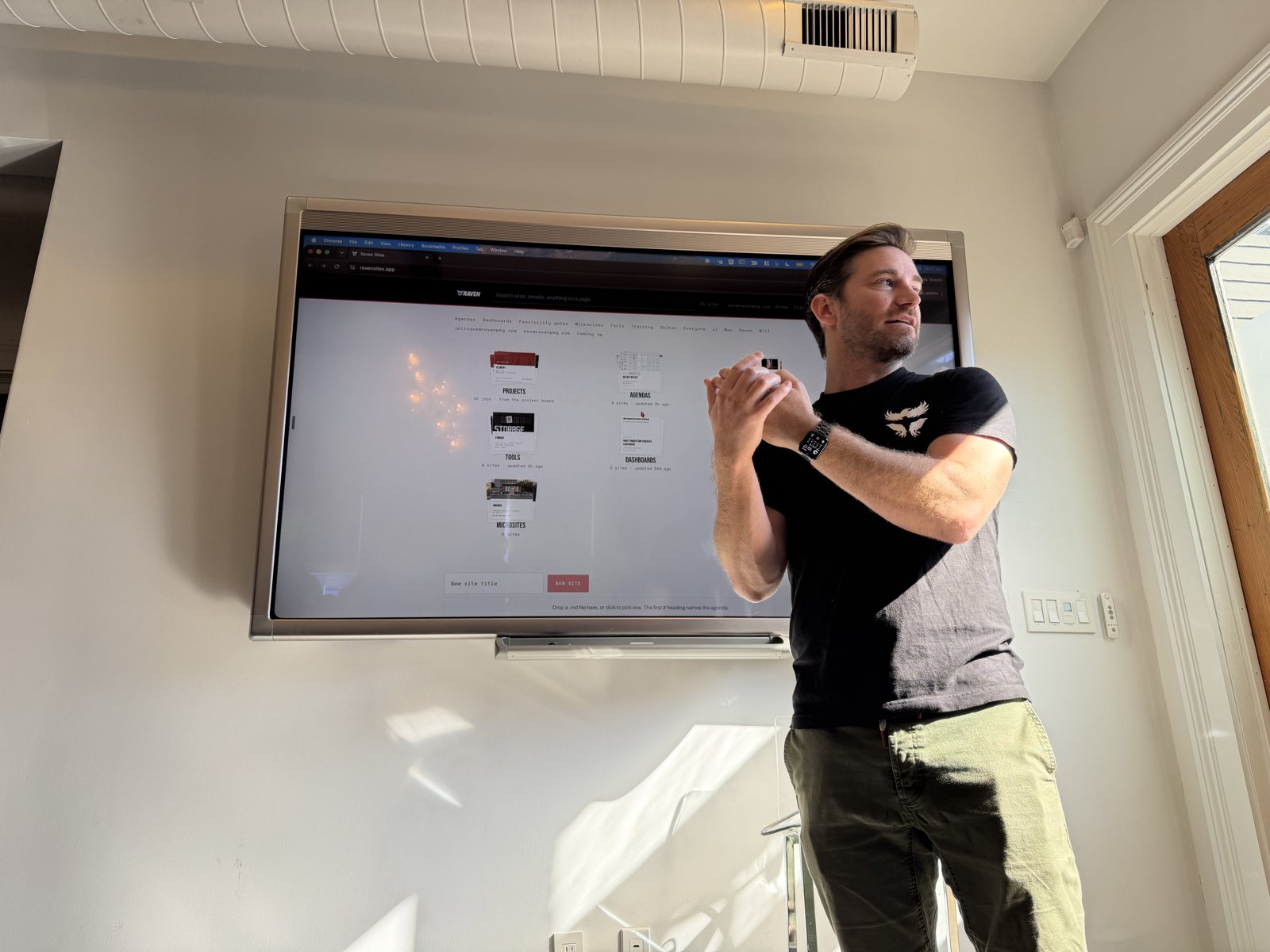
The projects view recreates the printed "war boards" in Raven's office: a pile of project cards you can drag around like papers on a desk. The same cards rearrange into a calendar, a process map that shows where every proposal stands, or a Gantt chart, and you can sort by account manager or project manager. Max said what he likes is that the screen doesn't disappear and get replaced. The same cards move into the view you need.
Max built the first examples himself so people could see that software doesn't have to look like a spreadsheet. After that the team took off. The person who used to keep all the staffing in his head described what he needed and made a staffing tool, which Max may show next time.
The board pushes changes one way for now. After a meeting where the team edits leads and dates on screen, a "copy prompt" button exports the changes as JSON. Max pastes that into his agent, which updates the source systems and drafts Slack messages to whoever has follow-up work. Max will share examples in Slack.
What we talked about
Voice input came up as a big unlock. One attendee said talking to the computer has been the biggest change for them in the last three weeks, because you stop trying to spec everything and just brain dump. Andrew agreed that prompt engineering matters a lot less than it did six months ago, and rambling out loud tends to carry the nuance the models need. Max rarely types anymore. He tried Apple's built-in dictation and an open-source model on his office AI server, and keeps coming back to Wispr Flow. Superwhisper and Handy came up as alternatives, and the Claude desktop app has voice input built in.
Tools mentioned
- Claude Duet: Anthropic's new proactive personal agent, announced this week as a research preview with a waitlist for Pro and Max plans.
- OpenAI dots: Always-on personal agents in ChatGPT, launched at Dev Day. Each dot gets its own cloud computer.
- Grok Bot: A personal agent with its own persistent cloud computer. Andrew and Dan both use it.
- Muse: Meta's personal AI agent.
- Claude Code: Brook built Align's site with it, including remote control from her phone, and her content writer edits the site through it.
- Ahrefs: SEO platform. Hello Gravel ran a nightly site audit and had an agent fix the issues it found during the migration.
- OpenSEO: SEO tool Andrew is trying in place of Ahrefs, now running on the AI Friday site.
- DataForSEO: An inexpensive API for SEO data that Andrew uses for monitoring.
- Wispr Flow: Voice dictation that works across apps. Max's main way of talking to AI.
- Superwhisper: Another voice-to-text app that came up as an alternative.
- Handy: A free, open-source speech-to-text app that runs offline.
- Storyflow: An AI canvas for organizing notes, boards, and documents, suggested to Max during his demo.