
Andrew Dunn opened the meetup with a look at what had changed since August, then the room moved into demos. Here’s his presentation.
What's new
A show of hands put Claude first for most people in the room. Andrew also brought up Dario Amodei’s essay, “We Must Pace the Frontier”, and the discussion around slowing AI development while the labs continue releasing new models.
Two release demos showed a different way to work with an assistant. In the Astra release video, someone talks through changes to a slide deck while the model operates the computer. Google’s Gemini 3.8 Live Extended Thinking post shows someone sketching an app and talking through it while Gemini builds.
Personal agents came up too: Grok Bot, Instinct, and Meta’s Muse. Andrew discussed reports that Amazon had blocked Muse from making purchases. If an agent shops for you, you may never see the ads Amazon puts in front of shoppers. That raises an interesting question about what agents will be allowed to do on other companies’ websites.
AI Recess
At Hello Gravel, Andrew gave a team photo to ChatGPT and asked it to make everyone goth, then tried turning the image into a video with Grok. The movement was fun, but the faces were a mess. Runway kept the faces looking much better, though the result was more static.
Carah from Hello Gravel took that experimentation further. She already had truck footage, product images, and the company’s brand, design, and voice guides in a folder. Using Runway, she made and scheduled social content through the end of October, including about a dozen gravel and dump-truck ASMR videos.
ChatGPT computer use did Andrew’s fantasy football draft. He also showed how he uses it to get through Rippling when Hello Gravel needs to onboard someone. Dan, Hello Gravel’s CEO, made a gravel delivery game that the team first played internally and then put in the website footer. Customers can play for a $100 coupon.
An attendee who works in sales enablement shared another game experiment. A friend built short breaks into a long certification program using Claude, including a Pac-Man-style game starring Oso, their Yeti character. Salespeople have started asking whether they can share it with customers.
Presentations and demos
Martin Holly, a hardware product designer moving into software, showed a gravel-themed video game he made with Claude and deployed on Vercel. He also showed his Family Dash, a screen running on a Raspberry Pi in his kitchen. It pulls together school newsletters, teachers’ notes, sports schedules, and GroupMe messages so his family can see things like a canceled practice without digging through every message. Grok Bot can add features when Martin emails it a request. He used Astra to improve the interface and Claude to deploy it, and mentioned pen.dev during the design discussion. Martin has more of his work on his website.
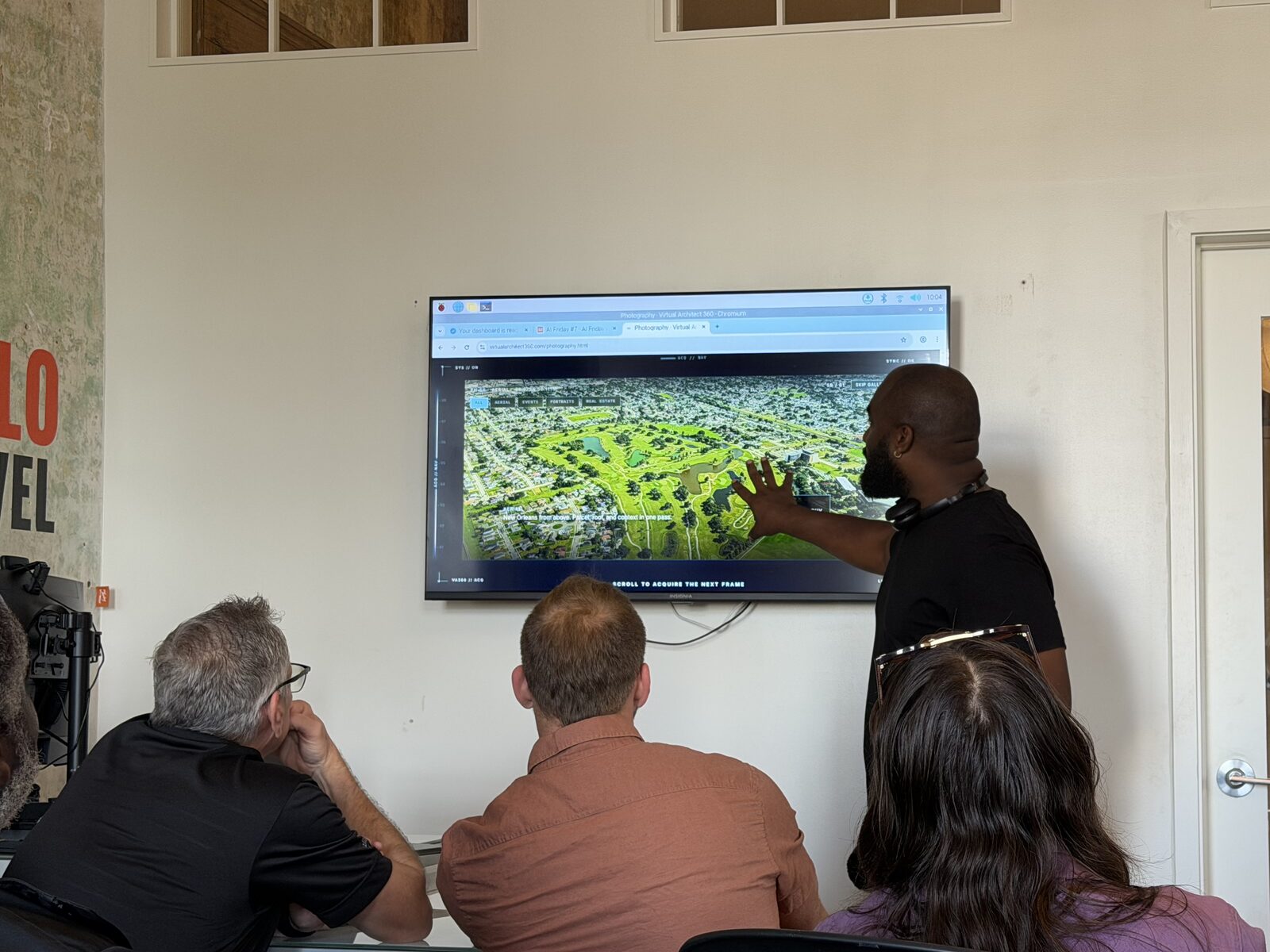
Lee Williams showed the Virtual Architect 360 website and agent he’s building for a drone photography and videography business. He used Grok Build for much of the site, with Google Antigravity, Claude Code, and Codex on different parts of the build. The site has scrolling transitions through the client’s photography. Behind it, an agent called LL Rowe helps organize the business and has collected 186 leads during prospecting tests. Lee showed how his client can change prospecting priorities, review a daily plan, and work through proposals. Connecting Granola meeting notes to an approval queue is still on his list. The demo also prompted a discussion about backups and access controls before more client data goes into the system.
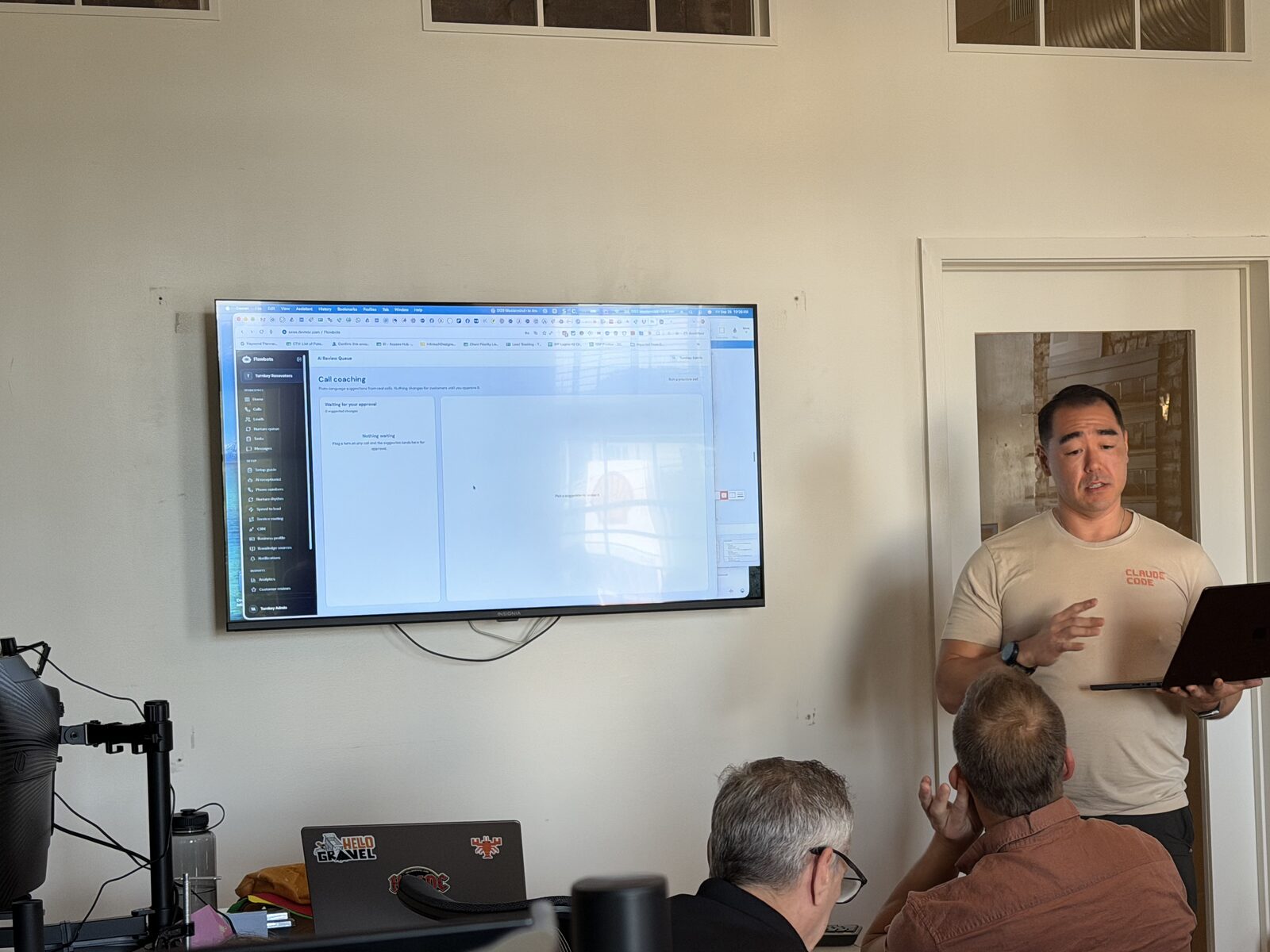
Brian Hong showed Flowbots, an AI system for handling calls, texts, and email with shared context across all three. His team has built versions for service businesses and is turning that work into software others can use. He walked through a voice agent that books appointments, updates a CRM, and hands off to a person when needed. The voice prototype used Vapi. To get an agent started, his team uses a business’s website, knowledge base, and existing call recordings rather than expecting an owner to write everything from scratch. Brian also discussed Big Easy Data, his data-enrichment business.
What we talked about
Computer use came up several times. The group compared giving an agent a browser it can operate with using Playwright for a scripted test. Both can be part of an AI workflow. The question is whether the steps are already known or the model needs to decide what to do as it goes.
Tools mentioned
- ChatGPT computer use: Lets an agent click through websites and applications. Andrew used it for a fantasy draft and onboarding. (learn.chatgpt.com)
- ChatGPT computer history: An opt-in timeline of activity across permitted apps and websites that ChatGPT and Codex can use as context. It’s separate from computer use. (learn.chatgpt.com)
- Grok Build: A coding agent Lee used while building the Virtual Architect 360 site.
- Grok Bot: A personal agent with its own persistent cloud computer. Martin used it with his Family Dash. (docs.x.ai)
- Muse: Meta’s personal AI agent, discussed in connection with shopping and Amazon.
- Instinct: A personal assistant that connects to apps and devices and can be contacted by text or phone.
- Hermes: An open-source agent that can connect to messaging apps, use tools, and retain memory across sessions.
- OpenClaw: An open-source assistant that runs on your own computer and connects to chat apps.
- Perplexity: An AI search tool that returns answers with links to its sources.
- Runway and Runway MCP: Image and video creation tools. The MCP connection lets an agent use Runway from ChatGPT, Claude, and other compatible apps. (runway.com)
- Google Antigravity: An agentic development environment Lee used for parts of the site’s design.
- pen.dev: A design canvas that Martin mentioned using with Claude.
- Granola: A meeting notepad that captures and organizes notes. Lee plans to feed meeting context into his agent.
- Vercel: The platform Martin used to deploy his gravel game.
- Raspberry Pi: The small computer running Martin’s kitchen dashboard.
- Minisforum: The mini PC hosting Lee’s client system.
- Tailscale: The private-network tool Lee uses to access that system remotely.
- NTFY: A push-notification tool Lee uses to send updates to his client’s phone.
- Playwright: Browser automation used in the discussion of scripted testing versus agent-directed computer use.
- BrowserStack: Runs browser tests across devices; Hello Gravel uses it to check its ordering flow.
- Vapi: A platform for building voice agents, used for Brian’s Flowbots voice prototype.
- Cekura: Tests voice agents with simulated conversations and monitors calls for problems. (cekura.ai)