
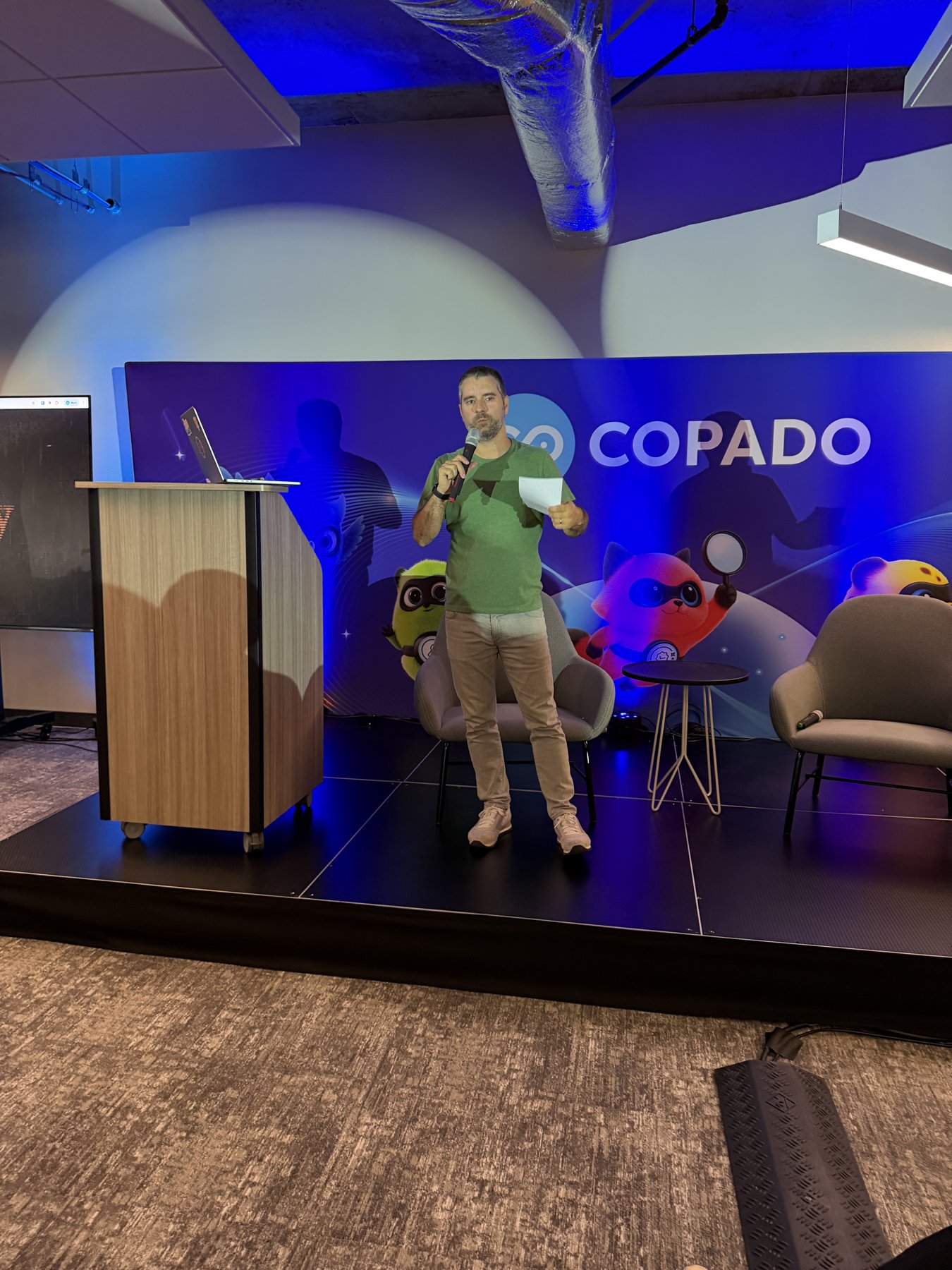
Thanks to Copado for hosting AI Friday #6!
Presentations and demos
Andrew Dunn, AI enthusiast from Hello Gravel, opened with a quick catch-up on what shipped since our July meeting. The deck counted 70 model releases across text, image, video, voice, music, transcription, sign language, and robotics. You can flip through the full deck and see the humanoid robot videos and links in this thread.
The deck also covered the expanding field of personal agents: OpenClaw, Hermes, BERD, Grok, Instinct, and a very different version of Napster.
Nicole Patel, Copado’s Chief People Officer, talked about AI and the job market. The Bullhorn applicant-tracking data she shared showed technology employment broadly flat rather than falling off a cliff. Her advice for people applying to jobs was direct. Use AI on your resume and cover letter because recruiters and hiring systems are already using it, then add enough of yourself that it does not read like everybody else’s AI output.
The job requirement is moving from “digital native” to “AI native,” but Nicole kept coming back to soft skills and human judgment. Copado is already putting agents on its org chart, with humans building, managing, and reviewing their work.
Dean Charbonnet, Copado’s VP of Agentic Operations, explained how that works internally. His team runs an agent factory for Copado employees. Someone can bring them a finished agent that needs deployment help, a rough prototype, or just an idea. Dean’s team helps turn it into something the company can use. The internal goal he described is for agents to fill 20% of new positions as Copado grows.
Gunnar Bach, a data scientist on Dean’s team, demoed an Import Wizard for marketing and sales data. After an event, prospect lists often arrived outside working hours and required a roughly 30-step, multi-hour process before the sales team could use them.
Now someone can drop in a CSV and run the import. The wizard checks the file against Salesforce rules and naming conventions, fixes casing and other cleanup issues, blocks records with missing required data, and gives a human a chance to review the flagged rows. Once approved, it finishes the import, monitors the job, and emails the owner if something fails.
Gunnar built it with Claude Code. His project’s CLAUDE.md holds the context and rules he does not want to repeat, including the current phase, changelog, state to remember, and a parking lot for ideas that should not interrupt the current build. He starts with a dry-run mode so an early mistake cannot pollute production data. He also bounces early plans and PRDs between Gemini and Claude, using the cheaper and faster model for more of the early iteration before moving into the build.
Gavin Pitre, Copado’s Director of Financial Strategy, showed how the finance team approached workflow automation. He is not a developer. Three months ago, he did not know what VS Code was. Now Copado is emailing him about how many AI tokens he is using.
The finance team started Q2 with a challenge to automate 250 workflows. By the time the work began, the math came to about seven new skills per day, so they cut the target to 50 and called it the Nifty 50. Their first attempt technically worked, but the output required so much editing that it erased the benefit.
They stepped back and defined a process covering discovery, documentation, build, test, and distribution. Each skill starts with a recorded walkthrough from the person who owns the workflow, plus the real inputs and expected outputs. AI turns that into a process map. The owner reviews it before the team writes a PRD or builds the skill. The team also created skills that build and test other skills against the approved examples.
By the end of Q2, they had shipped 50 production skills and 11 internal skills used to make them. Gavin’s line was “pay now or pay later.” A careful review at the beginning saves a much more painful editing cycle at the end.
Fekry Mostafa, a software engineer at Copado, started there as a support intern. Copado’s CEO had a PRD for an internal executive coaching app, and Fekry decided to try building it. He made the first version in about three hours on a Saturday using Cursor, ChatGPT for images, Groq for fast model inference, Supabase, and Vercel.
The app gives employees different coaching modes and uses company goals and business plans to keep the advice tied to the work. It shows scores for emotional state, motivation, and leadership over time. Fekry intentionally made the coach blunt.
The CEO shared it with the whole company. About 500 people signed up, and the app held around 100 daily active users for several months.
Fekry now does most of his work in Claude Code and builds custom skills for his own team. Two examples were user-story and Jira ticket generation that matches Copado’s actual QA process, and a bug-review bot adapted to run locally. The QA skill needed explicit guardrails so it would describe what to test in the interface instead of telling QA which lines of code to inspect.
What we talked about
Several demos included a failed or incomplete first attempt. Gavin’s first skills needed too much editing. Gunnar added dry-run protection before trusting his importer with real data. Fekry’s takeaway from the executive coach was to build something, send it out, and see what happens.
The agents are only part of the work. Somebody still has to own the process, document the inputs and outputs, review exceptions, manage access, and decide when the result is good enough to use. Copado has made that responsibility explicit enough to put an Agentic Operations team on the org chart.
Gavin’s experience made the point concrete. He went from not knowing VS Code to working on a system that shipped 50 finance skills in three months because the team made the process understandable and repeatable.