AI Friday #4
Friday, June 26, 2026
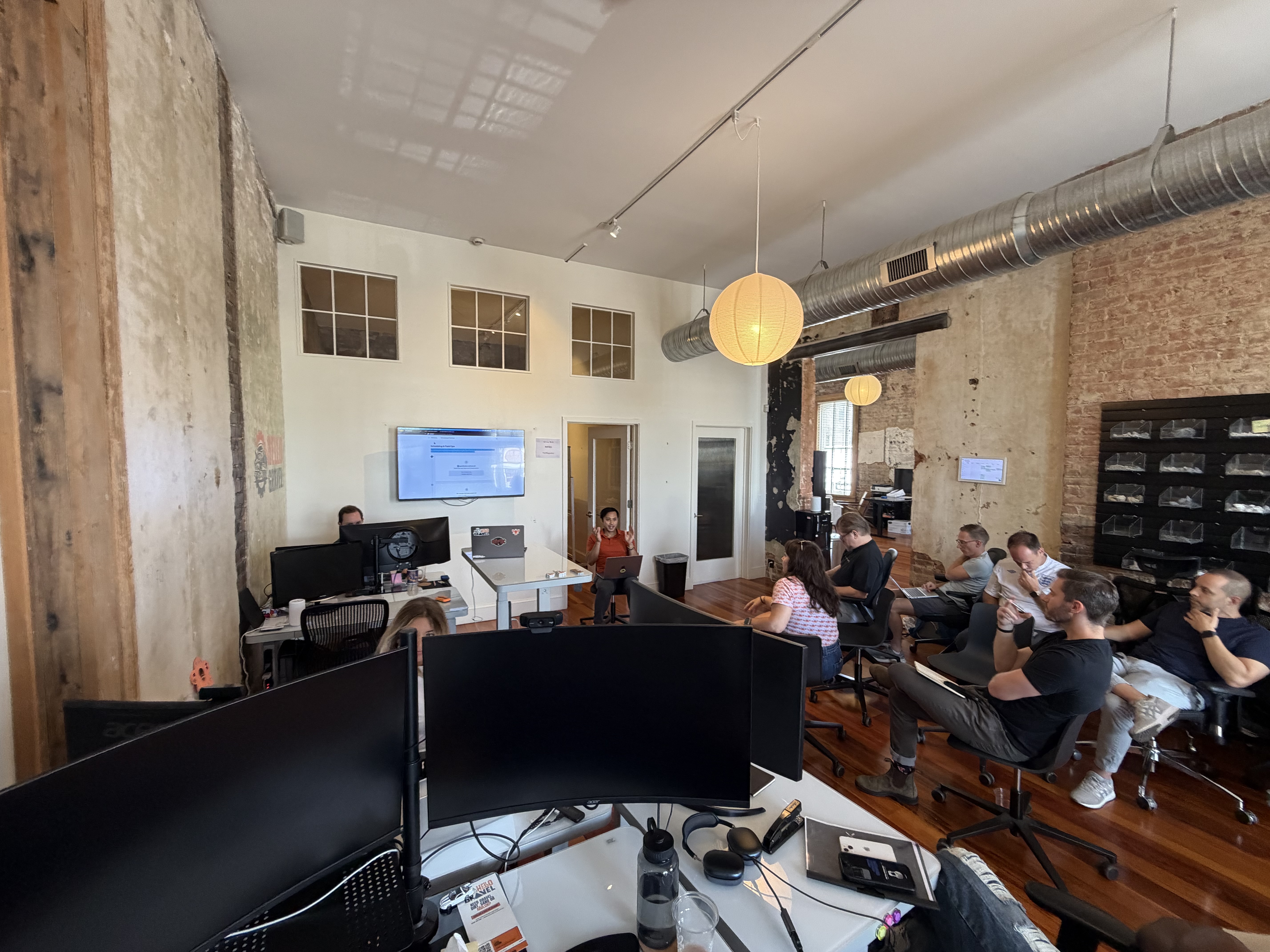
Demos
Max Materne took a 90-day operations engagement with a design/manufacturing company and built an orchestrator agent, named Athena, to run the business study before he ever set foot on the floor. It lives in a local folder-based file structure inside Claude Code, connected read-only to QuickBooks, Google Drive, and other sources, pulling in financials, org charts, and tribal knowledge. His framing: an agent is often just a well-organized file structure. A folder, a root instruction file, subfolders for roles and financials and workflows, and a model pointed at it. Get the structure right and you can move the whole thing between environments without rebuilding. For interviews across the 100-person org he uses a Plaud recorder with Wispr Flow filling in answers in real time, then feeds custom summaries back into Athena. One week in, the agent is already spotting role overlaps and duplicated work, and he can run analysis mid-meeting — a full cost/benefit on reusing shipping containers, mid-conversation. The plan: mature it locally, move the file structure to the cloud, and hand it to the client at the end of the engagement.
Laura Williams shared a personal knowledge system built on Granola and Obsidian. Granola captures meeting transcripts; a script runs a few times a day to parse them, Claude processes the notes, and Obsidian stores the output — sorted into ideas (including the ones that never get written down), research topics, and open questions. It generates a daily and weekly dashboard of lingering to-dos and surfaces a topic name when the team is talking around something they can't quite name. One aside: she would not recommend the Rabbit R1.
Brook Davis built Sipped, a bottle and drink-tracking app, solo, with no prior coding experience, guided entirely through Claude chat and the terminal. It runs a Supabase backend with the Claude API for image recognition, distributed through an Apple Developer account and TestFlight. Scan a bottle or a whole shelf, get details and tasting notes, save it to your library. The differentiator is a social layer that pulls in friends' preferences to recommend what to bring to their house. She's at around 15–20 users, including her 75-year-old mom, who uses it regularly and gives feedback. Scans run about $0.04 each, comfortably inside her $20/month Claude subscription.
Kevin Truong demoed Design OS, an open-source tool that interviews you on product vision and generates design tokens, data models, and a static React prototype with real UI components. He forked it and added deeper interview questions. His demo was a roofing field-management app for a client currently paying $600/month for JobNimbus — with a map-based polygon tool to measure roof area and calculate shingles, plus personas, pipelines, and a project map, all rendered as a working prototype. The workflow: Design OS produces a markdown and CSS handoff, then a separate Claude instance builds the actual app (Rails backend, React frontend). He's positioning it as an “MVP in a week” consulting offering and plans to open-source his fork with credit to the original author. People liked the commercialization angle: a repeatable service product rather than a dependency on a third-party design tool.
Lee Williams brought the morning's most ambitious build: Architect, with an internal program called Artisan. A physical installation of five computer nodes plus mobile nodes, a drum, and a VR environment, with an interface that's entirely voice and gesture — no keyboard or mouse — using a repurposed Xbox Kinect for gesture and haptic input. An orchestration layer routes tasks across up to eight AI models at once and consolidates responses in under a second. The first monetizable layer is BOSS, a business operations proxy that learns the owner's goals and strategy over time. It has its own email, phone number, personality, and voice recognition (owner-only admin commands), and it runs email campaigns, manages contacts, and monitors operations.
Nathan Stockman of YouthForce NOLA showed a soft-skills tracking platform for schools, built on Lovable, at softskillportal.com. It includes teacher dashboards, student and classroom surveys, an AI lesson planner, and a scenario generator. Teachers set grade, subject, goals, and targeted skills to produce lesson plans or discussion scenarios. He has 220 summer interns lined up to test from the student side, with former educators and the Operation Spark team testing too. His two questions opened the day's longest conversation: whether hosting student data in Claude-based systems is FERPA/COPPA-compliant, and what “AI fluency” should actually look like for students — meaning how to teach review and revision instead of treating the first output as final.
What We Talked About
Design tooling came up repeatedly — Canva, Figma Make, and Claude's design tooling for mockups and stylistic iteration. The consensus matched every other meeting: people are stitching together several imperfect tools rather than relying on one platform.
The privacy discussion around YouthForce's platform was the deepest. Mischa Krilov led the recommendations: for student data, lean on Gemini for Workspace, which is covered under an existing Google Workspace agreement and doesn't train on uploaded data. ChatGPT for Teachers came up as a free option (free through June 2027, then paid). Fable's 30-day prompt retention was cited as exactly the kind of enterprise data risk schools now have to weigh. A trend the group kept returning to: post-Fable, there's real interest in owning your compute and data instead of renting it from hosted services.
Andrew connected the AI-fluency question to a gap he keeps noticing: schools still treat AI use as cheating while many workplaces now treat it as normal, even necessary.
Tools Mentioned
- Claude (chat + Code) — primary build tool across nearly every demo
- Claude API — image recognition for Brook's Sipped app
- OpenAI / ChatGPT — referenced for image generation and general use
- ChatGPT for Teachers — free for K–12 teachers through June 2027; education-grade privacy
- Gemini for Workspace — recommended for student data (no training on uploads)
- Grok / xAI — mentioned in the SpaceX/xAI news thread
- Granola — meeting capture for Laura's knowledge system
- Obsidian — long-term note store for Laura's system
- Plaud — hardware recorder for Max's interviews (~$180–200)
- Wispr Flow — real-time voice-to-text during meetings
- Rabbit R1 — Laura owns one; does not recommend
- Supabase — backend for Sipped
- TestFlight — distribution for Sipped
- Canva — logo and design work; design-tools discussion
- Figma / Figma Make — AI prototype and artifact generation
- Design OS — open-source product-thinking tool Kevin forked and extended
- React — frontend for Design OS prototypes and built apps
- Rails — backend in Kevin's build workflow
- JobNimbus — the $600/month roofing tool Kevin's client wants to replace
- Lovable — build platform for the YouthForce soft-skills system
- QuickBooks — read-only source for Max's orchestrator agent
- Google Drive — read-only source for Max's agent
- Google Workspace — the agreement covering Gemini for Workspace
- Xbox Kinect — repurposed for gesture/haptic input (Lee)
- G-Stack — mentioned;
/csocommand flagged for code security review - softskillportal.com — Nathan's soft-skills platform
- MidJourney — pivoting into medical imaging hardware
- SpaceX — leasing compute to Anthropic; owns xAI; acquired Cursor
- Cursor — acquired by SpaceX (per the news recap)
- Anthropic — leasing SpaceX compute at $1.25B/month
- Astro — Hello Gravel's new site stack
- YouthForce NOLA — soft skills, internships, and career exploration in public high schools
- Operation Spark — partner testing the YouthForce platform